


- Messages
- 5,148
- Reaction score
- 2,286
- Points
- 113
Introduction
Reconstituting peptides is one of the most important—and most overlooked—steps in peptide research.On paper, the process is simple. In practice, small mistakes during reconstitution can affect peptide stability, reduce activity, and introduce variability into otherwise well-designed experiments.
If you’re working with sensitive compounds like tesamorelin, CJC-1295, or IGF-1, how you mix your peptide matters just as much as the peptide itself.
This guide breaks down the process step by step, along with the key principles that help maintain consistency from the moment your peptide leaves the vial.
Why Reconstitution Matters More Than Most Researchers Think
Peptides are supplied in a lyophilised (freeze-dried) state for one reason: stability.Once reconstituted, that stability begins to decline. Exposure to water allows chemical reactions such as hydrolysis and oxidation to occur, gradually breaking down the peptide structure.
This means reconstitution isn’t just preparation—it’s the point where:
- Stability begins to decrease
- Handling becomes critical
- Variability can be introduced
What You’ll Need
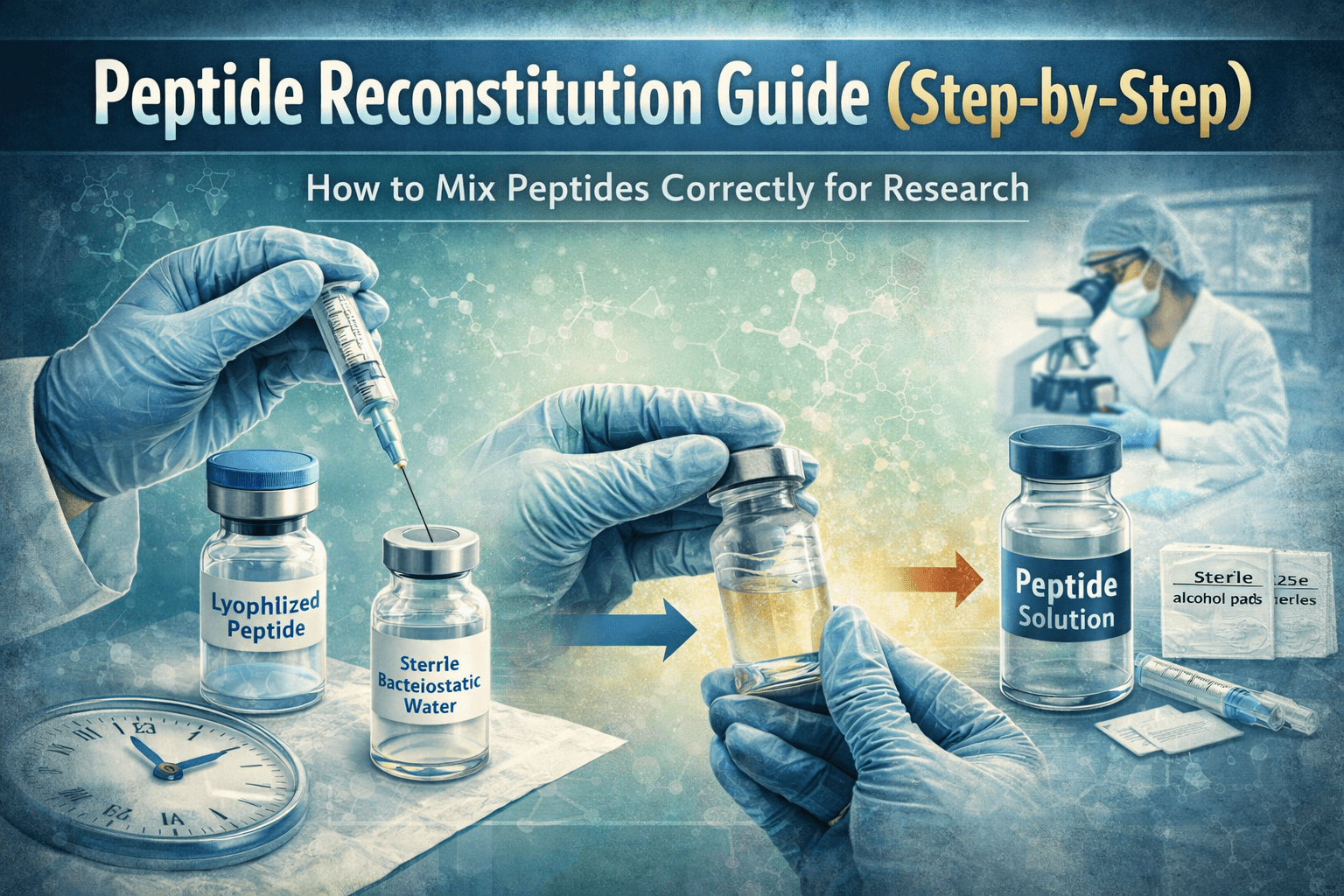
Before starting, set up a consistent and controlled workspace.You’ll need:
- A lyophilised peptide vial
- Sterile or bacteriostatic water
- A sterile syringe
- Alcohol wipes
Step-by-Step: How to Reconstitute Peptides Correctly
Step 1: Prepare a Clean Environment
Start with a clean surface and organised materials. Contamination at this stage can affect both stability and usability later.Step 2: Sterilise the Vial Tops
Wipe both the peptide vial and solvent vial stoppers with alcohol. This reduces the risk of introducing bacteria during the process.Step 3: Draw the Correct Amount of Solvent
Using a sterile syringe, measure your solvent carefully.The volume you choose determines your final concentration, so consistency here is key—especially if you’re comparing results across experiments.
Step 4: Add the Solvent Slowly
Inject the solvent slowly down the side of the vial rather than directly onto the peptide powder.This reduces foaming and helps preserve the peptide’s structure.
Step 5: Let It Dissolve Naturally
Allow the peptide to dissolve without interference. Most peptides will fully dissolve within a few minutes.If needed, gently swirl the vial—but avoid shaking entirely.
Step 6: Inspect Before Use
A properly reconstituted peptide should appear clear and free of particles.If anything looks off, it’s worth reassessing before proceeding.
The Most Common Mistakes (And Why They Matter)
Most peptide handling issues come from small, avoidable mistakes.Shaking the vial is one of the biggest. It introduces mechanical stress that can damage the peptide structure, even if the solution looks normal.
Adding solvent too quickly can cause foaming, which has a similar effect. Inconsistent dilution is another issue, often leading to unreliable dosing and inconsistent results.
These errors don’t always produce obvious signs—but they can quietly affect outcomes.
What Happens After Reconstitution
Once mixed, peptides enter a more fragile state.They are now exposed to:
- Water-driven degradation (hydrolysis)
- Oxygen and light (oxidation)
- Temperature-related instability
Storage After Reconstitution
After mixing, peptides are typically stored in refrigerated conditions to slow degradation.However, refrigeration only slows breakdown—it doesn’t stop it.
Over time, all reconstituted peptides will:
- Lose structural integrity
- Reduce in activity
- Become less reliable
Choosing the Right Solvent
Sterile water and bacteriostatic water are the most commonly used options.Sterile water is straightforward and widely used in single-use setups. Bacteriostatic water contains preservatives that help reduce microbial growth, making it more suitable for multi-use scenarios.
It’s important to note that neither option prevents chemical degradation—they only address contamination risk.
 Why Peptide Quality Still Matters
Even perfect technique won’t compensate for poor-quality material.High-purity, properly lyophilised peptides:
- Dissolve more consistently
- Maintain structure more effectively
- Produce more reliable results
Final Thoughts
Reconstitution is often treated as a basic step, but it plays a critical role in peptide research.It marks the transition from stability to sensitivity—and from that point on, technique matters.
By slowing down the process, standardising your approach, and understanding what happens after mixing, you can avoid many of the issues that lead to inconsistent or unreliable results.
In most cases, better handling leads directly to better data.
Frequently Asked Questions
What is the correct way to reconstitute peptides?Add solvent slowly down the side of the vial, allow the peptide to dissolve naturally, and avoid shaking.
Can you shake peptides after mixing?
No. Shaking can damage the peptide structure and should be avoided.
How long should you wait after reconstitution?
Most peptides dissolve within minutes. Once clear, they are ready for use.
What happens if peptides foam during mixing?
Foaming can indicate mechanical stress, which may affect peptide stability and activity.
Do all peptides require the same method?
The core process is similar, but some peptides are more sensitive and require extra care during handling.